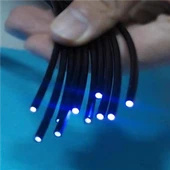
As a core component in modern optical communications and sensing technologies, the performance of fiber bundles depends largely on the primary materials used to construct them. Fiber bundles are typically composed of multiple closely spaced individual optical fibers, whose core materials primarily include quartz glass (silicon dioxide, SiO₂), plastics, and specialty optical glasses.
Quartz glass, particularly high-purity silica, is currently the most commonly used optical fiber material, due to its excellent optical transparency, low loss, and high mechanical strength. By doping with small amounts of other elements (such as germanium and phosphorus), the refractive index of the fiber can be precisely controlled, enabling efficient transmission of optical signals. Quartz fiber dominates the communications sector, particularly for long-distance, high-speed data transmission.
Plastic optical fiber (POF), another common optical fiber material, is primarily made of polymethyl methacrylate (PMMA) or polycarbonate (PC). Compared to quartz fiber, plastic optical fiber offers advantages such as flexibility, light weight, and low cost, making it suitable for short-distance data transmission, such as in-car communications, consumer electronics, and industrial sensors. However, plastic optical fiber suffers from high loss, limiting its transmission distance to typically no more than 100 meters.
In addition, in certain specialized applications, optical fiber bundles may utilize specialized optical materials such as fluoride glass and chalcogenide glass. These materials offer excellent infrared transmittance and are suitable for high-end applications such as military, medical, and astronomical observation.
In summary, the primary material for optical fiber bundles is quartz glass, supplemented by plastic optical fiber, and specialized glass materials tailored to specific needs. The choice of different materials directly impacts the performance, cost, and application range of optical fiber bundles, enabling them to meet diverse needs from communications to sensing.