

The advancement of modern communication technology has witnessed the extensive application of various types of cables. Among them, single core fiber optic cables and coaxial cables are two commonly used transmission media, each with unique features and applications. As a supplier of single core fiber optic cables, I will delve into the differences between these two cable types to help you better understand their characteristics and make informed decisions.
1. Physical Structure
The physical structure of a cable greatly influences its performance and application scenarios.
Single Core Fiber Optic Cable
A single core fiber optic cable consists of a core, cladding, buffer coating, and outer jacket. The core is the innermost part, which is usually made of glass or plastic, and it serves as the pathway for light signals to travel. The cladding, with a lower refractive index than the core, surrounds the core and helps to keep the light signals within the core through total internal reflection. The buffer coating provides mechanical protection to the core and cladding, and the outer jacket further safeguards the cable from environmental factors such as moisture, abrasion, and chemicals.
For example, our Plastic Fiber Optic Cable is designed with a plastic core, which offers flexibility and ease of installation, making it suitable for short - distance communication applications.
Coaxial Cable
A coaxial cable has a central conductor, an insulating layer, a metallic shield, and an outer jacket. The central conductor, typically made of copper or aluminum, is responsible for carrying electrical signals. The insulating layer separates the central conductor from the metallic shield, preventing signal leakage and interference. The metallic shield, usually made of braided copper or aluminum foil, provides electromagnetic shielding to reduce external interference. The outer jacket protects the cable from physical damage and environmental elements.
2. Signal Transmission Principle
The way signals are transmitted is a fundamental difference between single core fiber optic cables and coaxial cables.

Single Core Fiber Optic Cable
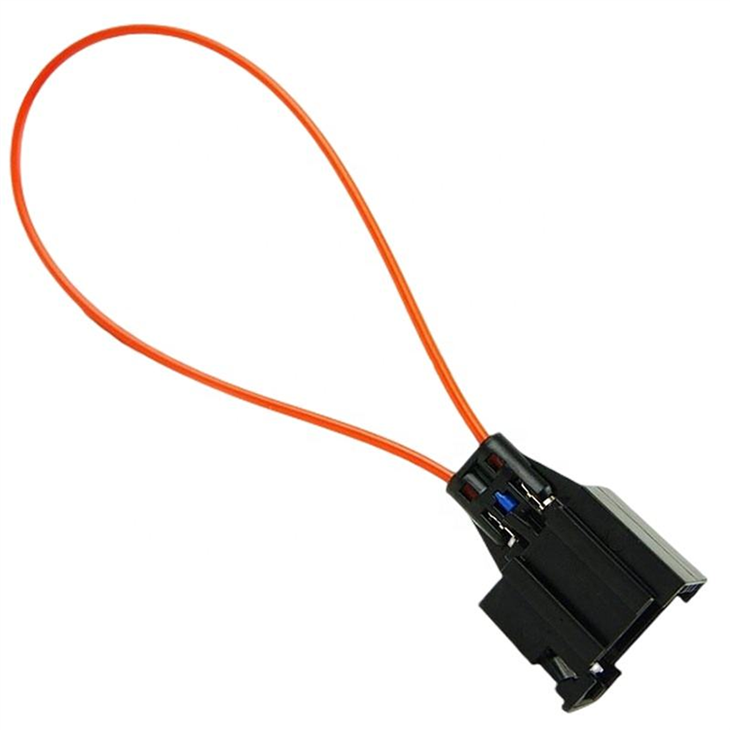
Single core fiber optic cables transmit data using light signals. The light source, such as a laser or an LED, emits light pulses that represent digital data. These light pulses travel through the core of the fiber optic cable by total internal reflection. Since light travels at an extremely high speed, fiber optic cables can achieve very high data transmission rates. Moreover, light signals are immune to electromagnetic interference (EMI) and radio - frequency interference (RFI), which ensures stable and reliable data transmission.
Our Dual - core Multimode Fiber Optic Cable takes advantage of this principle to provide high - speed data transmission over short to medium distances, suitable for local area networks and data centers.
Coaxial Cable
Coaxial cables transmit electrical signals. The electrical signals, which are variations in voltage or current, travel along the central conductor. As the signals propagate, they are subject to attenuation, which is the loss of signal strength over distance. In addition, electrical signals in coaxial cables are vulnerable to electromagnetic interference from external sources such as power lines, motors, and other electrical equipment.
3. Transmission Performance
Bandwidth
Single core fiber optic cables have an extremely high bandwidth, which refers to the range of frequencies that a cable can transmit. They can support data rates of several gigabits per second or even higher, making them ideal for applications that require large - scale data transfer, such as high - definition video streaming, cloud computing, and data center interconnects.
In contrast, coaxial cables have a relatively limited bandwidth. Although modern coaxial cables can support high - speed data transmission to some extent, their bandwidth is generally lower than that of fiber optic cables. As a result, coaxial cables may not be suitable for applications with extremely high data rate requirements.
Transmission Distance
Single core fiber optic cables can transmit signals over much longer distances than coaxial cables. For example, in long - haul telecommunications networks, fiber optic cables can transmit data over hundreds or even thousands of kilometers without significant signal degradation. This is because the light signals in fiber optic cables experience much less attenuation compared to the electrical signals in coaxial cables.
Coaxial cables are more suitable for short to medium - distance transmissions. In general, the maximum transmission distance of coaxial cables is limited to a few hundred meters, depending on the cable type and the data rate. Beyond this distance, signal boosters may be required to maintain the signal strength, which increases the cost and complexity of the system.
4. Cost
The cost factor is an important consideration when choosing between single core fiber optic cables and coaxial cables.
Single Core Fiber Optic Cable
The initial installation cost of single core fiber optic cables is relatively high. This is because the manufacturing process of fiber optic cables is more complex, and the associated equipment such as optical transceivers and connectors is also expensive. However, in the long run, fiber optic cables can be more cost - effective. They have a longer lifespan, require less maintenance, and can support future upgrades easily.
Our Orange PMMA Fiber Optic Cable provides a cost - effective solution for certain applications, combining the advantages of fiber optic technology with relatively lower costs.
Coaxial Cable
Coaxial cables generally have a lower initial installation cost. The materials used in coaxial cables are more common, and the installation process is relatively simple. However, as the demand for higher data rates and longer transmission distances increases, the cost of maintaining and upgrading coaxial cable systems may become relatively high. This is due to the need for more signal boosters and other equipment to meet the performance requirements.
5. Application Scenarios
The differences in performance and cost between single core fiber optic cables and coaxial cables result in different application scenarios.
Single Core Fiber Optic Cable
Single core fiber optic cables are widely used in long - distance telecommunications networks, such as telephone networks, internet backbone networks, and submarine cable systems. They are also commonly used in data centers for high - speed server - to - server connections and storage area network (SAN) applications. In addition, fiber optic cables are increasingly being used in home broadband networks to provide high - speed internet access.
Coaxial Cable
Coaxial cables are commonly used in cable television (CATV) systems, where they can transmit multiple channels of television signals over a single cable. They are also used in some local area networks (LANs), especially in older buildings or areas where fiber optic installation is not feasible. In addition, coaxial cables are used in some radio frequency (RF) applications, such as antenna connections and wireless base station backhaul.
Conclusion
In summary, single core fiber optic cables and coaxial cables have significant differences in physical structure, signal transmission principle, transmission performance, cost, and application scenarios. Single core fiber optic cables offer high bandwidth, long - distance transmission, and immunity to electromagnetic interference, making them suitable for high - speed and long - distance communication applications. On the other hand, coaxial cables have a lower initial cost and are more suitable for short - to medium - distance applications, especially in some traditional RF and cable TV systems.
If you are looking for high - quality single core fiber optic cables for your communication projects, please feel free to contact us. We can provide you with detailed product information and technical support to help you find the most suitable solutions for your needs.
References
- "Optical Fiber Communication Systems" by Govind P. Agrawal.
- "Coaxial Cable Technology and Applications" by various industry experts.