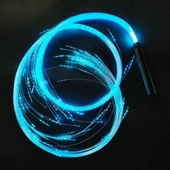
As the core medium for modern communications and data transmission, fiber optic cable occupies an irreplaceable position in the global information infrastructure due to its high bandwidth, low loss, and resistance to electromagnetic interference. Its technical scope encompasses multiple fields, including materials science, optical engineering, manufacturing processes, and system integration, and has demonstrated diverse application value in scenarios such as telecommunications, healthcare, industry, and defense.
Fiber Optic Cable Technology
1. Core Materials and Structural Design
The technical foundation of fiber optic cable stems from the use of high-purity materials such as quartz glass (SiO₂) or plastic. The classification of single-mode fiber (SMF) and multimode fiber (MMF) depends on the core diameter and transmission mode: single-mode fiber, with a core diameter of only 8-10 microns, is suitable for long-distance, high-speed communications; multimode fiber, with a larger core diameter (50-62.5 microns), supports short-distance, multipath data transmission. Furthermore, the design of the fiber's cladding and coating utilizes refractive index differences to control total internal reflection of light, enhancing mechanical strength and environmental tolerance.
2. Transmission Principles and Optical Properties
Optical fiber transmits light signals based on total internal reflection. Its low attenuation (single-mode fiber attenuation can be less than 0.2 dB/km at a wavelength of 1550 nm) far exceeds that of traditional copper cables. Dispersion management technologies (such as dispersion-compensating fiber) further optimize signal integrity, while wavelength division multiplexing (WDM) technology, by transmitting different wavelengths in parallel within the same fiber, increases the capacity of a single fiber to tens of terabits per second.
3. Manufacturing and Deployment Technologies
The fiber preform drawing process is a core manufacturing step, forming a continuous fiber core from high-temperature fused silica glass. The cabling process requires combining a strength core (such as aramid fiber), a jacket material (such as polyethylene), and an armor layer to accommodate aerial, duct, or submarine installations. Fusion splicing and connector technology (such as SC and LC connectors) directly impact system loss and maintenance efficiency.
Applications of Fiber Optic Cables
1. Telecommunications and Internet Infrastructure
Optical fiber forms the foundation of the global backbone network, carrying over 95% of international long-distance communications. 5G base station backhaul, data center interconnection, and metropolitan area networks all rely on the low latency of optical fiber. Companies like Google and Amazon are deploying dark fiber (inactive fiber resources) to meet future bandwidth expansion needs.
2. Dedicated Communications and Industrial Scenarios
In power systems, optical fiber composite overhead ground wires (OPGWs) combine power transmission and communications functions. Industrial Ethernet uses interference-resistant optical fiber instead of copper cables for automated production lines and oil and gas field monitoring. Medical endoscopes and laser surgical equipment also utilize optical fiber to transmit high-precision optical signals.
3. Defense and Aerospace
Military communication networks use encrypted optical fiber links to ensure information security, while satellite ground stations and deep space probes (such as Mars missions) use optical fiber for high-speed data downlink transmission. The aerospace sector is developing lightweight fiber-optic gyroscopes for navigation systems.
Future Development Trends
New optical fiber technologies such as space-division multiplexing (SDM), multi-core optical fiber, and photonic crystal fiber are pushing capacity limits. At the same time, green optical fiber manufacturing processes and intelligent operation and maintenance systems (such as distributed optical fiber sensing) will further reduce energy consumption and improve reliability. As global digitalization accelerates, the technical scope of fiber optic cables will continue to expand, becoming the cornerstone supporting the development of the metaverse, artificial intelligence, and the Internet of Things.
This article systematically explains the multidimensional technical scope of fiber optic cables and their cross-industry impact, from technical principles to industrial practices. It also highlights the deep integration of this field with precision engineering and innovative applications.